
Plastics are part of almost everything we use every day, from packaging and pipes to electronics, cars and medical devices. Bioplastics add another family of materials that can reduce fossil feedstock use, provide specific biodegradation functions, or both. The terms are easy to confuse, and neither origin nor biodegradability alone tells you whether a material is the best environmental choice. This guide separates the definitions and the practical processing questions.
1. What Are Standard Plastics?
Most conventional plastics used today are synthetic polymers made mainly from fossil feedstocks, although recycled and bio based feedstocks are growing. A polymer is a long chain built from repeating molecular units. For fossil based plastics, a common production route can be simplified into four main steps:
The global plastics industry operates at very large scale. Plastics Europe reported about 431 million tonnes of global plastics production in 2024. Scale is one reason many conventional grades have mature supply chains and well understood processing windows, although price and availability still vary strongly by polymer, region and energy cost.
2. The Main Types of Plastic Polymers
There are many different plastic polymers, each with its own properties and uses. Rather than listing every grade, it is more useful to group them into the main families.
| Family | Main types | Typical uses |
|---|---|---|
| Polyethylene (PE) | LDPE, HDPE, LLDPE | Packaging, films, bottles, pipes, containers |
| Polypropylene (PP) | Homopolymer, copolymer | Automotive parts, medical devices, containers |
| PET (polyester) | Bottle, film, fibre grades | Drink bottles, food containers, textiles |
| PVC | Rigid and flexible | Pipes, cables, profiles, medical devices |
| Polystyrene (PS) | GPPS, HIPS, EPS | Packaging, insulation, consumer products |
| Polyamide (nylon) | PA6, PA66, PPA, PEBA | Textiles, automotive, engineering parts |
| Engineering polymers | PEEK, PC, PMMA, PTFE | Implants, aerospace, optics, non-stick coatings |
2.1 Commodity Plastics
The main commodity families include polyethylene (PE), polypropylene (PP), polyvinyl chloride (PVC), polyethylene terephthalate (PET) and polystyrene (PS). PE covers LDPE, LLDPE and HDPE grades; PP is widely used in packaging, moulding and fibres; PVC is important in pipes, profiles and cables; PET is used in bottles, sheet, film and fibres; and PS covers rigid and foamed products. Their exact market shares vary by region and application.
2.2 Technical and Engineering Plastics
Engineering plastics include materials such as polyamide (PA), polycarbonate (PC), ABS, POM and PMMA, chosen for combinations of strength, dimensional stability, toughness, heat resistance or optical performance. Higher performance polymers such as PEEK, PPS, PEI and PTFE are used when temperature, chemical resistance, wear or other demanding properties justify the higher material cost.
A note for clarity: PLA and PEF can be processed with familiar plastics equipment, but they belong in the bioplastics discussion because they can be produced from renewable feedstocks. PEF is a durable bio based polyester and should not be assumed to be biodegradable.
3. What Are Bioplastics?
European Bioplastics defines a bioplastic as a plastic that is bio based, biodegradable, or both. These are two separate properties: origin describes where the carbon feedstock comes from, while biodegradability describes what microorganisms can do to the material under specified environmental conditions.
Two properties are involved, and they must not be confused, because this is the most common mistake made with these materials:
- Bio based means the material is made, fully or partly, from renewable biomass such as corn, sugarcane, potatoes or cassava, instead of from fossil oil.
- Biodegradable means the material can be broken down by microorganisms into water, carbon dioxide and biomass under defined conditions.
These properties are independent. Bio based PE is chemically equivalent to conventional PE and is not biodegradable. PBAT is normally fossil based but biodegradable; whether a finished PBAT product is industrially compostable depends on the formulation, product thickness and certification against the relevant standard. The correct end of life route therefore has to be decided for the actual product, not from the word “bioplastic” alone.
4. How Bioplastics Are Made
There is no single method for all bioplastics. The route depends on the material. In practice there are four main routes.
4.1 Direct Extraction
Some polymers already exist in nature and only need to be extracted and refined. Cellulose comes from wood pulp or plant fibres, starch from crops. Starch blends are a common example, where starch is combined with other biodegradable polymers in an extruder.
4.2 Fermentation and Polymerisation — the PLA route
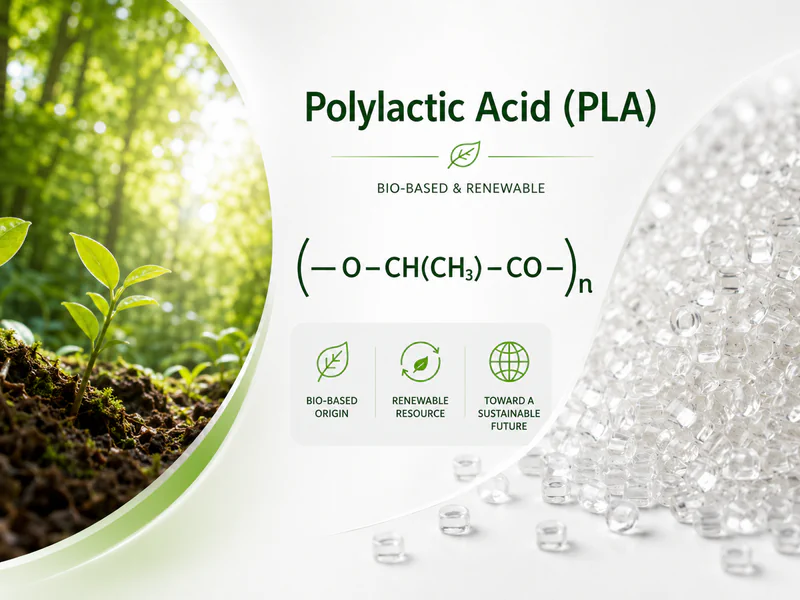
This is the most important industrial route. Sugar or starch from corn or sugarcane is fermented by microorganisms to produce lactic acid. The lactic acid is purified and then polymerised into PLA, usually by first forming a molecule called lactide and then building long chains through ring-opening polymerisation.
4.3 Microbial Production — the PHA route
For PHA, microorganisms produce and store the polymer inside their own cells as an energy reserve. The cells are then harvested and the polymer is extracted and purified. This route is more complex, which is one reason PHA is more expensive than PLA.
4.4 Drop-In Route
Sugar from sugarcane can be fermented into ethanol, then converted into ethylene and finally into bio based polyethylene. The result is chemically identical to ordinary polyethylene and can be used in the same machines and recycling systems. These are called drop-in materials.
5. The Main Types of Bioplastics
The clearest way to organise the many bioplastic materials is to place them in three groups, based on whether they are bio based, biodegradable, or both.
| Group | Meaning | Examples |
|---|---|---|
| Bio based, not biodegradable | Drop-in materials, same as fossil plastics | Bio PE, bio PET, bio PA, PEF |
| Bio based and biodegradable | Renewable origin and able to break down | PLA, many PHA grades, some PBS grades, selected starch blends |
| Fossil-based but biodegradable | From oil, but still compostable | PBAT, PCL and other biodegradable fossil based polymers |
5.1 The Most Important Materials
Polylactic acid (PLA) is a widely used bio based polyester made from fermented sugars. It is used in packaging, fibres, 3D printing and other products. Many PLA products can be designed to meet industrial compostability requirements, but PLA should not be described as something that simply disappears in normal soil, seawater or a home compost heap.
Polyhydroxyalkanoates (PHA) are a family of polyesters produced by microorganisms. Different PHA grades can show biodegradation in a wider range of environments than many other plastics, but the rate and extent depend on the polymer, product thickness, temperature, microorganisms and exposure conditions. PHA materials are being developed for packaging, agriculture, medical and other applications.
Starch and cellulose provide renewable feedstocks for many plastic and coating systems. Some starch blends and cellulose derived materials are biodegradable, while others are chemically modified or blended for durability. The finished formulation and certification determine the correct disposal route.
Drop in materials such as bio PE and bio PET are chemically equivalent to their fossil counterparts and can use established PE or PET recycling streams where those streams accept the product. PEF is an emerging bio based polyester with strong barrier potential for selected packaging applications, but its recycling infrastructure is not yet as widespread as PET. PBS can be fossil based, partly bio based or bio based depending on the feedstock route, and is biodegradable under suitable conditions. Other specialised materials include PTT and PGA.
6. Plastics and Bioplastics Compared
Standard Plastics
- Mostly fossil feedstocks today, with recycled and renewable feedstocks increasing
- Large, mature supply chains for PE, PP, PVC, PET, PS and engineering polymers
- Most conventional grades are durable rather than biodegradable
- Established mechanical recycling routes for major polymer streams where collection and sorting exist
- Very wide range of prices, properties and processing windows
Bioplastics
- Defined as bio based, biodegradable, or both
- Includes durable drop in materials as well as biodegradable polymers
- End of life route is material and product specific: recycling, industrial composting or other treatment
- Global production capacity remains small compared with total plastics production
- Processing, drying and thermal stability depend strongly on the specific grade
Do you need to compare standard plastics, recycled plastics and bioplastics?
You can test the material in a controlled way and gain practical process knowledge before moving to full scale production.
7. Advantages and Disadvantages
7.1 Advantages of Standard Plastics
- Durable and versatile, from packaging to construction, electronics, aerospace, solar panels and EV parts.
- Cost-effective, generally cheaper to produce than most alternatives.
- Mature and reliable, with well-understood properties and large-scale supply.
7.2 Disadvantages of Standard Plastics
- Most conventional grades are not biodegradable and can persist when they escape collection systems.
- Production still relies heavily on fossil feedstocks.
- Environmental impact depends on product design, service life, collection, reuse and recycling, not only the polymer name.
7.3 Advantages of Bioplastics
- Bio based grades can reduce dependence on fossil feedstocks.
- Some biodegradable grades provide a useful end of life function in applications designed for organic waste or controlled biodegradation.
- Drop in bio based polymers can keep familiar processing and, for PE and PET, established recycling routes.
7.4 Disadvantages of Bioplastics
- Many grades remain more expensive or less widely available than established fossil based polymers.
- Processing windows, drying requirements and heat stability can differ from familiar PE or PP grades.
- Biodegradable does not mean litter safe, marine degradable or home compostable; certified products need the correct collection and treatment infrastructure.
- Environmental performance varies by feedstock, manufacturing, product design, transport, use and end of life, so life cycle assessment is more useful than broad “green” claims.
8. Applications
8.1 Standard Plastics
Standard plastics are used almost everywhere. The largest market is packaging, including bottles, bags and containers. They are also widely used in construction, electronics, transport, and countless consumer goods.
8.2 Bioplastics
Bioplastics are used across packaging, fibres, consumer goods, automotive applications, agriculture and selected medical products. Packaging remains the largest market segment. Soil biodegradable mulch films are a specific certified application; ordinary biodegradable or compostable packaging should not be assumed to biodegrade safely in soil.
9. Recycling and End of Life
9.1 Single-Layer and Multilayer Plastics
Plastic packaging can be single-layer or multilayer. Single-layer plastics are simpler in structure and generally easier to recycle. Multilayer plastics give better barrier and performance properties, but the mix of materials makes them more difficult to recycle.
9.2 Recycling of Standard Plastics
There are three main routes: mechanical recycling (sorting, melting and reforming), chemical recycling (breaking plastics down into chemical building blocks for reuse), and energy recovery (using plastics as fuel through controlled incineration). Mechanical recycling is the most common, but works best with clean, single-material streams.
9.3 End of Life for Bioplastics
Bioplastics do not share one end of life route. Bio PE and bio PET can be recycled with their conventional counterparts because they are chemically and physically equivalent. Other polymers such as PLA can be mechanically recycled when they are separately collected and sorted. Certified industrially compostable products need controlled composting conditions and an accepting local collection system. Correct identification, sorting and local infrastructure matter more than the generic “bioplastic” label.
10. Market Tendencies and Future Outlook
Bioplastics are still a small part of the total plastics market, but capacity is expanding and material options are becoming more diverse. The strongest drivers differ by application: reducing fossil feedstock, meeting product carbon targets, improving circularity, or adding a controlled biodegradation function where it has a clear benefit.
European Bioplastics and the nova Institute reported global biobased plastics production capacity of about 2,31 million tonnes in 2025, with a forecast of about 4,69 million tonnes by 2030. In 2025, actual production was about 1,67 million tonnes, or roughly 72% of available capacity. Packaging represented 41,3% of global capacity. The association estimates biobased plastics capacity at around 0,5% of the approximately 431 million tonnes of plastics produced globally each year.
The practical trend is toward more feedstock options, improved material performance, better sorting and recycling, and more precise claims about compostability and biodegradation. For processors, the important point is that every new grade still needs to be tested for drying, melt temperature, residence time, shear sensitivity, cooling and final product performance before full production.
Conclusion
Conventional plastics and bioplastics overlap in processing technology but differ in feedstock, chemistry and possible end of life routes. Most conventional plastics still use fossil feedstocks. Bioplastics may be bio based, biodegradable, or both. None of those labels alone proves that one product has a lower environmental impact than another.
The right material depends on performance, processing, cost, service life, available collection and end of life infrastructure. For extrusion development, the safest approach is to test the real grade under controlled conditions, document its processing window and compare the finished product before moving to production scale.
Working with plastics or bioplastics?
At Green Extrusion Technology we design laboratory and all-around extruders that process both conventional plastics and bio based polymers — for teaching, testing, and small scale production. We are glad to help you find the right setup.
Test PLA, PHA, recycled blends and new formulations safely at small scale.
Explore LabEx →From 18 to 30 mm, for pipes, profiles, filament and co-extrusion.
See extruders →Tell us about your material and we will suggest a practical solution.
Contact us →