
Introduction
Testing a new plastic material directly on a production blown film line may look like the fastest way to get an answer.
In many cases, it is also the most expensive way.
A production line is built to produce film. It is not built for repeated small tests, formulation changes and material trials. When a company uses a production extruder for testing, it often uses large amounts of raw material, energy, operator time and production capacity. If the test does not work, the result can be scrap, purge waste, cleaning time and lost production.
A laboratory blown film extruder gives companies, schools, universities and R&D teams a practical way to test materials, recipes and process settings on a smaller and more controlled scale.
It can be used for virgin polymers, recycled materials, bio-based materials, biodegradable compounds, masterbatch, additives and film structure development.
The main idea
A laboratory extruder gives your team a practical and controlled way to test materials, develop recipes and understand process behaviour before moving to full-scale production. It helps reduce waste, save production time and make material development more structured.
What is a laboratory blown film extruder?
A laboratory blown film extruder is a compact extrusion line used for testing and development of plastic film. It works in the same basic way as a production blown film line, but on a smaller scale.
The process includes the same main steps:
Plastic pellets, recycled granules, additives or blends are fed into the extruder.
The screw transports, melts and mixes the material inside the heated cylinder.
The melt passes through the die head and is inflated into a film bubble.
The bubble is cooled, collapsed into flat film, pulled and wound onto a small roll.
This means that a laboratory blown film line includes the same basic process elements as a production line: feeding system, extruder screw, cylinder, heating zones, melt pressure control, die head, air ring, film bubble, take-off unit, winder and HMI.
The difference is size, material consumption and flexibility. A laboratory extruder is smaller, easier to clean and easier to use for trials. It is designed for testing, learning and development work.
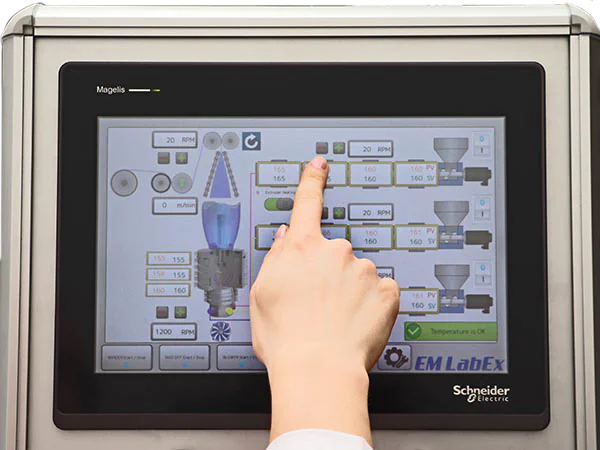
What is a test extruder, lab extruder or mini extruder?
The same type of equipment can be described with different names, depending on the application and the industry.
A test extruder is normally used to test materials, additives, colours, masterbatch or recipes before full-scale production.
A mini extruder is a compact extruder used for development work, teaching, small-scale trials and process learning.
A laboratory extruder is designed for professional testing in a laboratory, R&D department, technical school, university or technical centre.
When the machine is well equipped, it can be used for much more than simple testing. It can support recipe development, operator training, film sample production, process comparison, material screening and preparation for scale-up.
The names can be different, but the purpose is the same: to test the material in a controlled way and gain practical process knowledge before moving to full-scale production.
What is a laboratory extruder used for?
A laboratory blown film extruder can be used for many practical tasks. It can test new polymer grades before production. It can compare different suppliers of the same polymer type. It can test recycled material and check if it gives stable film. It can test bio-based or biodegradable materials, where the processing window may be narrow.
It can also test masterbatch, colour, additives and film structures.
For a film producer, the lab extruder can be used to make small film samples for internal evaluation or for customers. For a technical school, it can be used to teach the process step by step. For a university, it can be used for polymer research and material development.
- Material testing and recipe development
- Film sample production
- Operator training
- Testing recycled plastic and bio-based materials
- Testing masterbatch, colours and additives
- Testing mono-layer, ABA, 3-layer and project-specific 5-layer structures
- Preparing production trials
- Comparing material suppliers
Controlled testing before full-scale production
You can test the material in a controlled way and gain practical process knowledge before moving to full-scale production.
Why production trials are expensive
A production extruder is made to produce saleable film. When it is used for testing, several costs appear at the same time.
Raw material is consumed during start-up, adjustment and unstable running. If the trial fails, much of this material becomes scrap. The line must then be cleaned or purged before returning to normal production.
Operators, supervisors and technicians spend time on the trial. The line also uses energy during the test, even if no saleable product is produced.
The largest cost is often hidden. While the production line is used for testing, it is not producing normal customer orders.
This is why many companies underestimate the real cost of production trials. A laboratory extruder helps reduce this risk because many questions can be answered before the material reaches the production line.
What a laboratory blown film line helps you understand
A good laboratory test can answer practical questions:
- Does the material feed well?
- Does it melt evenly?
- Does the pressure stay stable?
- Does the bubble remain stable?
- Does the film have gels, black spots or poor surface?
- Does the colour disperse correctly?
- Does the material need drying?
- Does the temperature window seem narrow?
- Can it be used as mono-layer film, or in a 3-layer or project-specific 5-layer structure?
A data sheet can give useful information, but it does not show everything. Real extrusion behaviour depends on the material, the screw, the temperature profile, residence time, shear, die design, cooling and film take-off.

Key advantages of a laboratory blown film extruder
1. Much lower material consumption
A production line may need a large quantity of material before the process becomes stable. A laboratory line uses much less material. This is important when testing expensive polymers, additives, colour masterbatch, bio-based materials or recycled material with limited availability.
2. Faster recipe development
When the machine is smaller, it is normally faster to start, adjust, stop and clean. This makes it easier to compare different recipes, blend ratios, masterbatch levels or temperature profiles in a structured way.
3. Reduced production downtime
Testing on a lab line keeps the production line free for normal production. The production team can continue making saleable film while R&D or the technical team performs trials in the lab.
4. Better preparation before scale-up
A laboratory extruder gives the team a strong starting point before moving to full-scale production. It can help identify a practical temperature window, melt pressure behaviour, screw speed range, bubble stability, film appearance and material sensitivity before production capacity is used.
The final settings on the production line may still need adjustment. This is normal because a production line can have a different screw configuration, residence time, shear level, die size, cooling system and output range.
The important advantage is that the team does not start from zero. The laboratory test gives useful process knowledge that can make the production setup quicker, easier and more controlled. It can reduce start-up time, reduce scrap and make scale-up more structured.
5. Better operator training
A laboratory blown film extruder is a good training tool. New operators can see how temperature, screw speed, air flow, take-off speed and die settings affect the film bubble. They can learn the process without disturbing production.
6. Safer testing of difficult materials
Recycled materials can vary from batch to batch. Bio-based materials can be moisture sensitive or thermally sensitive. Additive-rich compounds can create pressure or dispersion issues. A laboratory extruder allows these materials to be tested in a smaller and safer environment.
7. Better film samples for customers
A lab line can produce small film samples for internal testing or customer evaluation. This is useful when a customer asks for a new film structure, new colour, new material or more recycled content.
8. Better understanding of material behaviour
When tests are done in a smaller controlled setup, the team can observe the material more carefully. They can see how the material reacts to temperature changes, screw speed, cooling and take-off speed.
9. Lower risk when testing recycled materials
Recycled materials can contain variation in melt flow, moisture, contamination and thermal history. A lab extruder can be used to compare batches, test blend ratios and check film stability before committing the production line.
10. Quick payback potential
A laboratory extruder is an investment, but the correct question is not only the purchase price. The better question is: how much does each production trial really cost?
When polymer waste, purge material, energy, operator time, supervisor time and lost production are included, many companies are surprised by the result.
Depending on material cost, production waste, downtime and labour cost, some companies achieve payback after a relatively small number of production trials. A payback calculation should always be based on the company’s own figures and on the real cost of production testing.
Material price, waste level, production value, cleaning time, downtime and labour cost can all change the result. For that reason, fixed payback numbers should be used only as examples, not as a general promise.
Ask for a payback calculation
Green Extrusion Technology can calculate how many tests are needed before a laboratory extruder can pay for itself, based on your own material cost, energy cost, operator time and production trial waste.
Looking for financial solutions?
If the investment should be financed or supported through an export or investment solution, ask Green Extrusion Technology for a clear quotation and technical scope. For Danish finance and export support information, you can also visit EIFO.
Mono-layer, ABA, 3-layer and project-specific 5-layer laboratory extruders
The right laboratory extruder depends on what you need to test.

Mono-layer laboratory extruder
For basic film testing, material screening, training, simple recipes, colour tests, additive tests and process window evaluation.

ABA and 3-layer laboratory extruders
For recycled middle layers, different inside and outside layers, barrier tests, sealing layers and multilayer packaging concepts.
Mono-layer laboratory blown film extruder
A mono-layer line produces film from one material stream. It is normally the simplest and most affordable solution. A mono-layer lab extruder is often the right choice for schools, simple material testing, operator training and companies that mainly need to understand how one material behaves.
ABA laboratory blown film extruder
An ABA line is a 3-layer concept where the outside layers are the same material type and the middle layer can be different. A typical structure is A / B / A. This is useful when you want to test recycled material in the middle layer while keeping better quality material on the outer layers.
3-layer laboratory blown film extruder
A 3-layer line gives more flexibility than a mono-layer line. It can test different materials in each layer and is useful for companies working with packaging, recycled content, sealing layers or functional film structures.
5-layer laboratory blown film extruder
A 5-layer laboratory blown film extruder is used when the film structure is more advanced. It gives more possibilities to test barrier layers, tie layers, recycled layers, sealing layers and special functional materials. At Green Extrusion Technology, 5-layer systems should be treated as project-specific configurations and must be checked against the required application before quotation.
A 5-layer laboratory line can be useful for high-performance packaging film, barrier film development, food packaging concepts, recycled content in controlled layer structures, bio-based film structures and advanced material combinations.

Cost, space and operation
Is a laboratory extruder expensive?
A laboratory extruder has a cost, but it should be evaluated as a production and development tool. If a company only looks at the purchase price, the investment can look large. If the company compares it with the real cost of production trials, the picture often changes.
A production trial may include raw material waste, purge material, energy, operator time, supervisor time, cleaning time, lost production, delayed customer orders, unstable start-up and off-spec film.
Does a laboratory extruder require a large space?
Normally, no. Laboratory blown film extruders are compact compared with production lines. They can often be placed in a laboratory room, technical centre, training room or R&D area. Many systems are delivered as compact units and can be placed on wheels, depending on configuration.
Is it difficult to run a laboratory extruder?
A laboratory extruder should be easy to operate. Green Extrusion Technology designs laboratory extruders to be operator friendly. The operator can work with the basic process controls in a clear way.
The machine includes the same basic components as a production extruder, but on a smaller scale. This makes it easier to understand the process.
How long does it take to run a lab extruder test?
The time depends on the material, the machine and the test objective. A simple material check can often be done much faster than a production trial. More advanced tests, such as multilayer structures, drying comparisons or additive evaluation, need more time.


Who benefits from a lab extruder?
Blown film converting companies
- Test new materials before production.
- Reduce production line downtime.
- Produce customer samples faster.
- Compare material suppliers.
- Test recycled content levels.
- Check masterbatch and additives.
- Prepare better production trials.
- Train operators without stopping production.
- Reduce scrap from failed trials.
- Improve technical confidence with customers.
Technical schools
- Teach real extrusion with a practical machine.
- Show the process from pellets to film.
- Train operators in temperature control.
- Demonstrate screw speed and pressure behaviour.
- Teach bubble stability safely.
- Let students see common film defects.
- Run small material batches.
- Teach mono-layer and multilayer principles.
- Connect theory with real operation.
- Prepare students for plastics industry work.
Polymer universities
- Test new polymers under real processing conditions.
- Produce film samples for research.
- Study melt behaviour.
- Compare material blends.
- Test additives and fillers.
- Evaluate bio-based polymers.
- Study recycled materials.
- Produce samples for testing.
- Support student projects.
- Build links between research and industry.
Plastic recyclers
- Test recycled pellet quality.
- Compare recycled batches.
- Check melt strength and bubble stability.
- Test blends with virgin material.
- Evaluate filtration and contamination effects.
- Produce film samples for customers.
- Check odour, gels and black spots.
- Test drying and preparation.
- Reduce risk before selling material.
- Improve technical documentation for recycled grades.
Bioplastic and biomaterial companies
- Test bio-based polymers before scale-up.
- Evaluate biodegradable film behaviour.
- Check moisture sensitivity.
- Study thermal stability.
- Find the right temperature window.
- Test film forming behaviour.
- Compare blends and compounds.
- Produce customer or certification samples.
- Reduce expensive material waste.
- Move from material idea to practical film sample faster.
R&D and quality teams
- Screen material options.
- Document process windows.
- Compare film appearance.
- Check pressure behaviour.
- Test before customer trials.
- Reduce avoidable scale-up problems.
- Make repeatable sample films.
- Support sales with technical samples.
- Train internal teams.
- Build long-term process knowledge.
What materials can be tested?
A laboratory blown film extruder can be used for many materials, depending on machine configuration. Typical examples include:
- LDPE, LLDPE and HDPE
- PP and selected polyolefin blends
- Multilayer structures containing PA, EVOH and other barrier materials when the laboratory line is configured for these applications
- Recycled granules, including PE-based recyclates, PCR and PIR materials
- Bio-based polymers, including Bio-PE where relevant
- Biodegradable and compostable compounds
- Masterbatch, colour additives and functional additives
The machine configuration must match the material and the test objective. Some materials need drying. Some need special screw design. Some need careful temperature control.
This is why it is important to define the purpose of the machine before ordering.
How lab testing supports full-scale production
Laboratory testing gives practical process information before production capacity is used. It helps the team understand the material, compare recipes and prepare a more structured path to full-scale production.
Final production settings may still need adjustment because production machines have larger screws, higher outputs, different residence times, different cooling conditions and different winding systems.
This is where the lab test gives its value. The production team already knows the basic processing window, the material sensitivity and the likely process direction. That reduces uncertainty and makes scale-up more controlled.
A laboratory extruder is strongest when it is used for material screening, recipe comparison, training, early process development, film sample production and pre-production preparation.
How Green Extrusion Technology can help
Green Extrusion Technology supplies laboratory extruders and compact extrusion systems for material testing, film development, operator training and small-scale production.
The LabEx range can be configured for different testing needs, from simple mono-layer extrusion to more advanced blown film applications. Project-specific multilayer configurations must be checked against the material, structure and test objective.
- Mono-layer laboratory blown film extruders
- ABA laboratory blown film extruders
- 3-layer laboratory blown film extruders
- Project-specific 5-layer laboratory blown film extruders
- All-around extruders for flexible testing work
- Special configurations for research, training and material development
The machines are designed to be compact, practical and easy to operate. They are suitable for companies and institutions that want a real extrusion process in a smaller format.
Request price and technical information
Ask Green Extrusion Technology for information about mono-layer, ABA, 3-layer or project-specific 5-layer laboratory blown film extruders.
Frequently asked questions
What is a lab extruder?
A lab extruder is a small extrusion machine used for testing materials, recipes and process settings. It works like a production extruder, but on a smaller scale.
What is a test extruder?
A test extruder is a compact extrusion machine used to test materials, additives, colours, masterbatch or recipes before full-scale production.
What are mini extruders used for?
Mini extruders are used for small-scale testing, teaching, material development, sample production and process research.
What is a laboratory extruder used for?
It is used to test polymers, recycled materials, bioplastics, masterbatch, additives, process settings and film structures before production.
Is a laboratory extruder expensive?
It is an investment, but the payback can be fast when compared with the real cost of production trials. Green Extrusion Technology can prepare a payback calculation based on your own figures.
Is it difficult to run a lab extruder?
Green Extrusion laboratory extruders are designed to be easy to run and operator friendly. They include the same basic process elements as a production line, but in a smaller and more controlled setup.
What is the difference between mono-layer, ABA, 3-layer and 5-layer lab extruders?
A mono-layer extruder produces one material layer. An ABA line produces a 3-layer A/B/A structure. A 3-layer line allows different functional layers. A 5-layer line gives more possibilities for barrier layers, tie layers, recycled layers and advanced film structures.
Can a laboratory extruder test recycled plastic and bioplastics?
Yes, if the machine is configured correctly for the material. Recycled materials, bio-based polymers and biodegradable compounds often benefit from controlled testing before production.
Conclusion
A laboratory blown film extruder helps companies test smarter.
It lowers material waste, supports operator training and gives R&D teams a practical tool for developing new films. It helps recyclers and bioplastic companies understand material behaviour before scale-up.
Most importantly, it gives better process information before full-scale production.
A laboratory extruder makes material development more controlled, more structured and easier to document.
If your company tests new polymers, recycled materials, additives, masterbatch or bio-based film materials, a laboratory blown film extruder can become one of the most useful tools in your technical department.
Next step
Visit Green Extrusion Technology to see laboratory extruders, blown film lab lines and compact extrusion systems. You can also ask for price information or a payback calculation based on your own trial costs.