
How a Blown Film Extrusion Line Works: Bubble Formation, Cooling and Stability
A practical Green Extrusion Technology guide for technical readers who want to understand blown film extrusion, improve process knowledge and evaluate materials before production trials.
What Part 2 covers
This second article focuses on bubble formation, cooling and stability, where the visible film shape is created and controlled.
- Die head function and melt distribution
- Air ring cooling and frost line behaviour
- Blow up ratio, drawdown and orientation
- IBC, bubble cages and stability control
Blown Film Extruder Explained: 4-Part Series
This connected guide follows the complete process from polymer feeding and melting to bubble control, winding, materials and laboratory testing. Open any part below.
The bubble is where the film is created
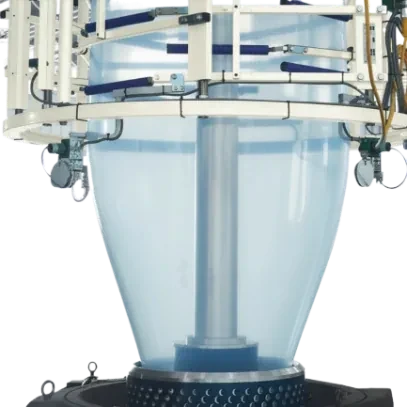
After the polymer is melted, filtered and distributed through the die head, the process becomes visible as a film bubble. This is the most recognisable part of blown film extrusion, but it is also one of the most sensitive.
The bubble is formed when air inflates the molten tube. At the same time, cooling air removes heat and the film starts to solidify. The balance between output, die gap, air volume, cooling, haul-off speed and material melt strength defines the bubble shape.
Stable bubble formation is important for film thickness, width, clarity, mechanical properties and roll quality. A laboratory line is ideal for studying these relationships because it allows a technical team to test one change at a time.
Die head function in blown film extrusion
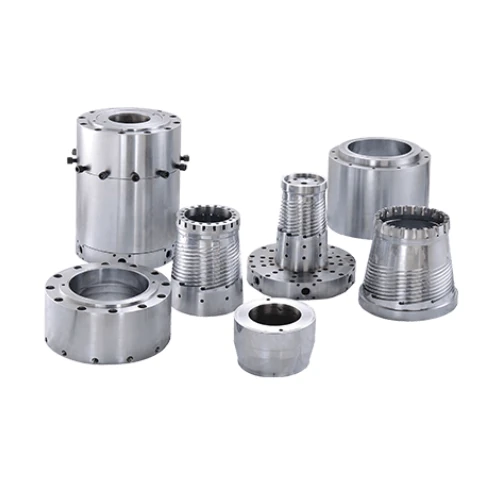
The die head converts the circular melt flow from the extruder into a thin annular melt tube. The die must distribute the polymer evenly around the circumference. If flow is not balanced, the film can show thickness bands, die lines or unstable bubble behaviour.
Spiral mandrel dies are widely used because they help distribute melt around the die with good balance. The die gap, die temperature, material viscosity and cleanliness of the die lips all influence the final film.
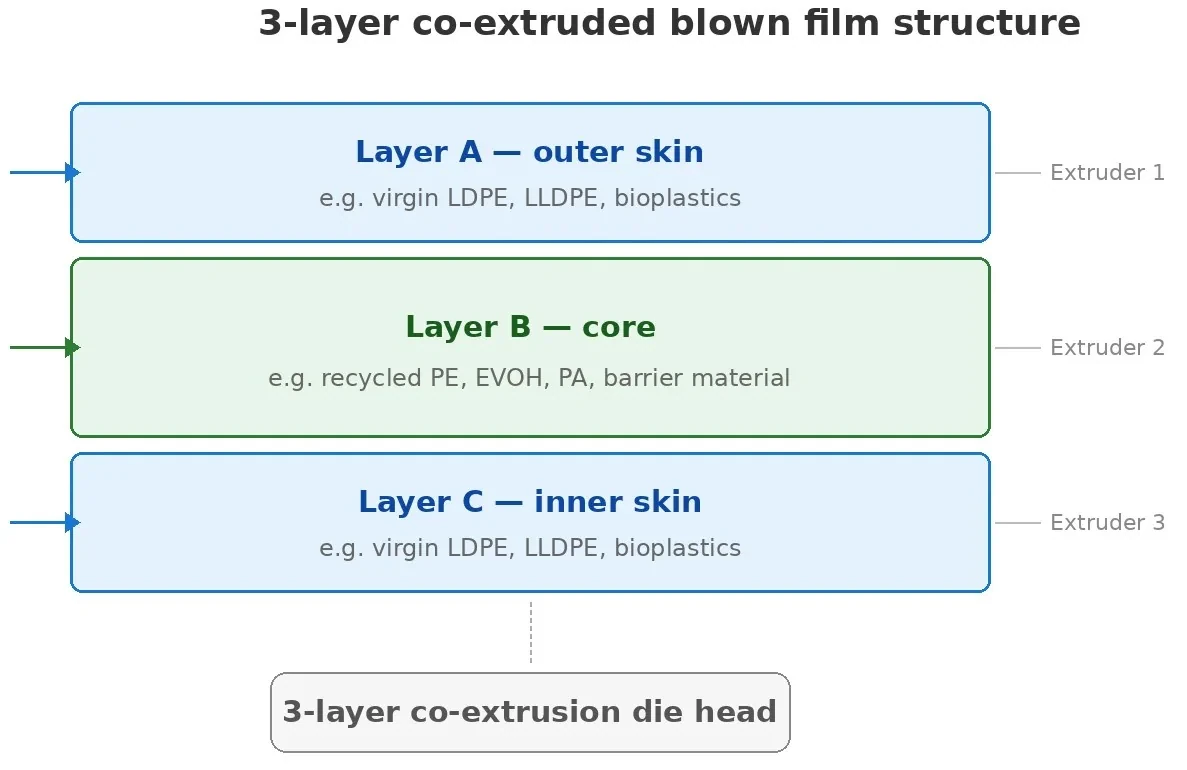
For multilayer film, the die must also maintain layer distribution. Layer ratios, melt temperature and viscosity matching are critical for optical appearance, barrier performance and adhesion between layers.
Practical point: Balanced melt distribution at the die head is one of the main conditions for stable bubble formation and even film thickness.
Air ring and external cooling
The air ring cools the bubble from the outside. Its job is not only to cool quickly, but to cool evenly. Uneven cooling can create gauge variation, local frost line differences, poor clarity and bubble instability.
Air ring adjustment should be done carefully. Too much air can make the bubble flutter, while too little cooling can raise the frost line and make the bubble soft for too long. The right setting depends on material, output and die size.
Air filters, hoses and air ring passages must be clean. A partially blocked air ring can create a local high or low cooling zone that is later seen as a thickness band or winding problem.
Bubble stability indicators
| Indicator | What it suggests | What to check |
|---|---|---|
| Stable frost line | Good heat balance | Keep settings and record the window |
| Breathing bubble | Air leakage or unstable output | Check pressure, IBC and nip sealing |
| Local high frost line | Uneven cooling or die flow | Check air ring and die temperature |
| Fluttering bubble | Excessive air or drafts | Check air ring velocity and environment |
| Poor clarity | Cooling or material issue | Check resin, temperature and frost line |
Frost line and film solidification
The frost line is the visible area where the film changes from molten or soft to solid. It is one of the most useful visual indicators in blown film extrusion. A stable frost line usually means the balance between heat input, cooling and output is stable.
A frost line that is too high can make the bubble soft and unstable. A frost line that is too low can freeze the film before the intended orientation is developed. The correct position depends on the material and product.
For material development, frost line behaviour gives practical information about melt strength, cooling response and processability. This is especially useful for recycled and bio-based materials, where behaviour can differ from standard PE.
Blow-up ratio, drawdown and orientation
Blow-up ratio is the relationship between bubble diameter and die diameter. It influences transverse direction properties and film width. Drawdown relates to how much the melt is stretched in the machine direction by the haul-off system.
The combination of blow-up ratio and drawdown affects tensile strength, tear behaviour, shrinkage, gauge stability and appearance. A film can look acceptable but still have poor mechanical balance if the process is not set correctly.
LabEx blown film trials can be used to compare how different materials respond to blow-up, drawdown and cooling. This gives useful practical knowledge before larger scale production runs.
Engineering note: Orientation is created by how the bubble is inflated and drawn. This is why small changes in process ratios can affect film strength and appearance.
Internal bubble cooling and bubble cages
Internal bubble cooling, often called IBC, cools the bubble from the inside as well as from the outside. It can increase output and improve cooling control on suitable lines. The system must be stable because unstable internal air can cause layflat and width variation.
A bubble cage or calibrating basket helps guide the bubble. It should support the bubble without squeezing or forcing it. If the cage is too tight, misaligned or dirty, it can create marks, scratches or instability.
On laboratory blown film lines, a simple and well-designed bubble support system makes it easier to observe material behaviour, compare settings and train operators.
Why it matters: A well adjusted support and cooling system helps the operator compare materials and settings without unnecessary bubble disturbance.
LabEx insight for bubble stability
Bubble stability is one of the clearest indicators of whether a material is suitable for blown film. With LabEx, a processor can compare virgin PE, recycled PE, bio-based materials and additive packages under controlled conditions.
The laboratory line allows the user to observe frost line, bubble breathing, gauge variation, clarity and film handling with a small material quantity. This creates process knowledge that is valuable for production planning and customer trials.
The objective is not only to make a sample. The objective is to understand how the material behaves and where the useful operating window is.
Common bubble formation problems
Bubble instability can be caused by unstable output, insufficient melt strength, uneven air ring flow, external drafts, wrong frost line position or poor cage adjustment. A structured troubleshooting method should separate the extruder, die, cooling and tower effects.
Gauge variation around the circumference often points to die, air ring or cooling imbalance. Machine direction variation often points back to extruder output or haul-off instability.
When developing new materials, it is better to test stability in a controlled laboratory setup before a production line is stopped for trials.
Study bubble stability with controlled laboratory trials
LabEx blown film lines help technical teams compare materials, cooling settings, frost line behaviour and film stability before production trials.
Continue the 4-part blown film guide
This article is part of a connected technical series. Use the next articles to understand the full blown film line from pellets to finished film and material testing.
FAQ
What is the frost line in blown film extrusion?
The frost line is the area where the film changes from molten or soft to solid. It is a useful visual indicator of cooling and process stability.
What does the air ring do?
The air ring cools the bubble from the outside. Even cooling is important for stable film thickness, clarity and bubble shape.
Why does a blown film bubble become unstable?
Instability can come from output variation, wrong cooling, low melt strength, air leaks, external drafts or incorrect bubble cage adjustment.
Why test bubble stability on a LabEx line?
A LabEx line allows material behaviour, cooling response and bubble stability to be studied with small material quantities and controlled settings.
Sources
This article is based on Green Extrusion Technology product knowledge and practical extrusion experience.