
How a Blown Film Extrusion Line Works: Haul Off, Thickness Control and Winding
A practical Green Extrusion Technology guide for technical readers who want to understand blown film extrusion, improve process knowledge and evaluate materials before production trials.
What Part 3 covers
This third article focuses on film handling after the bubble, where haul off, gauge control and winding determine final roll quality.
- Collapsing frame and nip rolls
- Thickness control and gauge variation
- Surface treatment, slitting and edge quality
- Winding tension and roll build
Blown Film Extruder Explained: 4-Part Series
This connected guide follows the complete process from polymer feeding and melting to bubble control, winding, materials and laboratory testing. Open any part below.
Film quality must survive the tower and winding section
A stable bubble is not enough. The film must also be collapsed, pulled, guided, treated, slit and wound without creating wrinkles, scratches, blocking or poor roll geometry.
The haul-off and winding section is where many visible defects become obvious. Some defects start earlier in the line, but the tower and winder can amplify them. For this reason, film handling must be treated as a technical process, not only as a mechanical afterthought.
This article explains how the film moves from bubble to roll and how good control in this section supports product quality.
Collapsing frame and bubble flattening
The collapsing frame converts the round bubble into a flat web. The frame must be centred, clean and adjusted to the correct angle. If the collapse is not symmetrical, the film can develop wrinkles, edge folds or tension differences.
The film temperature at the collapsing point is important. If the film is too hot, it can block, stick or wrinkle. If it is too cold or stiff, it may not collapse smoothly. The correct condition depends on material, thickness and line speed.
For operator training, laboratory lines are useful because the collapse behaviour can be observed clearly at smaller scale and with lower material use.
Nip rolls and haul-off speed
The nip rolls close the bubble and pull the film upward. Haul-off speed controls film drawdown and therefore film thickness together with output and die gap. A small change in nip speed can change gauge, mechanical orientation and layflat width.
Nip rolls must be parallel, clean and correctly loaded. Uneven nip pressure can create web wander, wrinkles and trapped air. Air leakage through the nip can also cause unstable bubble size.
The haul-off drive should run smoothly. Speed variation can appear as machine direction gauge variation or repeating marks in the finished roll.
Film handling defects and typical sources
| Defect | Possible source | First check |
|---|---|---|
| Wrinkles | Bubble, collapsing frame, nip or winder | Find where the wrinkle first appears |
| Gauge bands | Extruder, die or cooling | Separate MD and TD variation |
| Blocking | Film too warm, pressure or formulation | Check film temperature and winding tension |
| Telescoping | Winder, tension or edge guiding | Check roll hardness and web guide |
| Poor printability | Treatment or surface contamination | Measure dyne level and check side treatment |
Thickness control and gauge variation
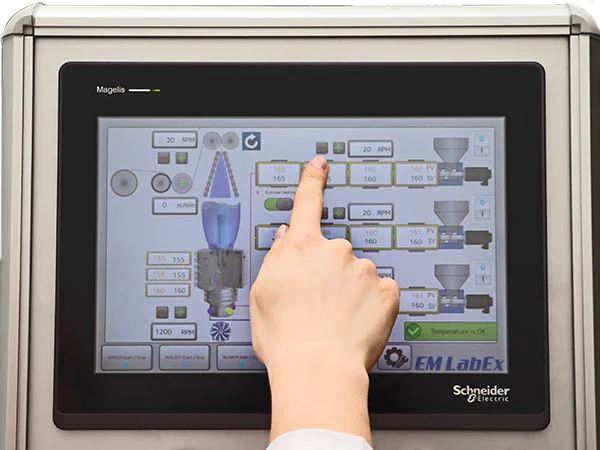
Film thickness is influenced by output, die gap, cooling, blow-up ratio and haul-off speed. Machine direction variation often comes from output or speed instability. Transverse direction variation often comes from die, air ring or cooling imbalance.
Production lines may use thickness scanners and automatic gauge control. Laboratory lines normally rely on controlled settings and measured film samples. Both approaches require accurate records.
Thickness should be measured across the web and along the web. A single average value is not enough to understand film quality.
Why it matters: Film thickness control depends on stable settings and good records. The image supports the link between process control and measured film quality.
Corona treatment and surface preparation
Corona treatment increases surface energy so that film can be printed, laminated or coated. The treatment side, treatment level and storage time are important. Too little treatment can create poor ink adhesion. Too much treatment can create sealing or blocking problems.
Treatment settings must match line speed and product requirements. The correct side of the film must be treated and marked clearly for the next process step.
For product development, treatment behaviour should be part of the test plan when the film will be printed or converted.
Slitting, trimming and edge quality
Trim knives, slitting knives and edge trim systems must be sharp, correctly adjusted and clean. Poor edge quality can create dust, fuzzy edges, web wander and converting problems.
Static electricity can make edge trim or dust return to the web. This can cause contamination and surface marks. Good housekeeping around the slitting and winding area is important.
Laboratory trials can produce small film rolls for practical handling, sealing or printing evaluation. This is useful when a customer needs a sample before production approval.
Winding and roll build
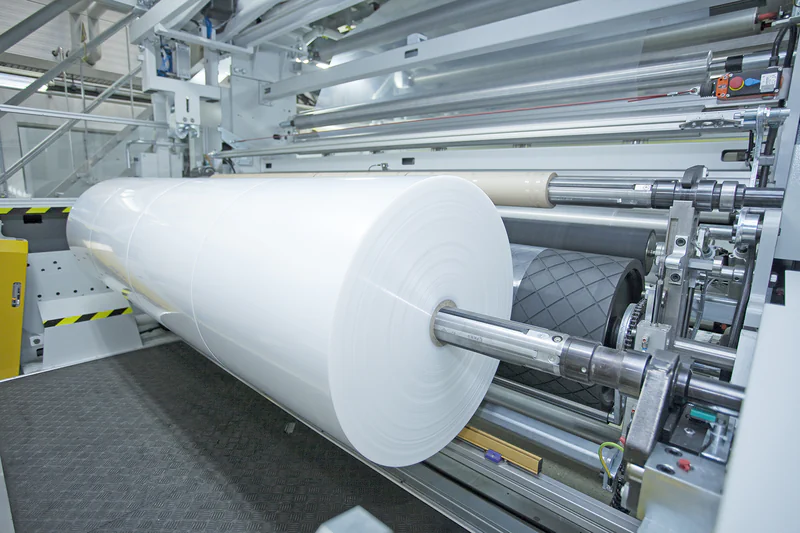
The winder must create a roll that is firm, straight and easy to unwind. Winding tension, taper tension, lay-on pressure, core quality and film temperature all influence roll quality.
Common winding problems include telescoping, hard rolls, loose rolls, starring, blocking and crushed edges. These problems may be caused by the winder itself, but they can also come from gauge variation or poor film cooling earlier in the line.
Good winding settings should be recorded by product. A repeatable winding recipe is just as important as a repeatable extrusion recipe.
Practical point: A well adjusted winder protects the work done earlier in the line and helps deliver rolls that unwind well in the next process step.
LabEx and Multi-X insight for film handling
LabEx blown film lines are useful when a team needs to make small film rolls for evaluation. The same line can be used to compare recipes, film handling, clarity, sealing behaviour and basic roll quality.
Multi-X extruders can support broader material development when the same polymer must also be tested as a strand, rod, small profile or compact extrusion sample. This is useful for recyclers and material suppliers that serve several application areas.
The combination of laboratory film production and flexible extrusion testing helps the customer move from material idea to practical sample faster.
Create film samples before production trials
LabEx blown film lines make it possible to produce small film rolls for evaluation, formulation work, operator training and customer samples.
Continue the 4-part blown film guide
This article is part of a connected technical series. Use the next articles to understand the full blown film line from pellets to finished film and material testing.
FAQ
What does the haul-off do in blown film extrusion?
The haul-off pulls the film upward, closes the bubble and helps define film thickness through drawdown.
Why do wrinkles appear after the bubble is collapsed?
Wrinkles can come from gauge variation, poor collapse, misalignment, uneven nip pressure, excessive tension or winding problems.
Why is winding tension important?
Winding tension controls roll hardness and unwind quality. Too much or too little tension can create roll defects.
Can a laboratory blown film line make useful sample rolls?
Yes. A LabEx line can make practical film samples and small rolls for material evaluation, sealing tests, appearance checks and customer trials.
Sources
This article is based on Green Extrusion Technology product knowledge and practical extrusion experience.