
How a Blown Film Extrusion Line Works: Materials, Formulations and Testing Strategy
A practical Green Extrusion Technology guide for technical readers who want to understand blown film extrusion, improve process knowledge and evaluate materials before production trials.
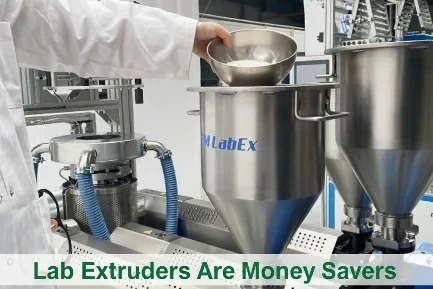
What Part 4 covers
This final article focuses on materials, formulations and testing strategy, where the choice of polymer defines the process window and film performance.
- PE, barrier and specialty material groups
- Recycled and bio based material trials
- Additives, masterbatch and formulation work
- Practical laboratory testing strategy
Blown Film Extruder Explained: 4-Part Series
This connected guide follows the complete process from polymer feeding and melting to bubble control, winding, materials and laboratory testing. Open any part below.
Materials define what the line can achieve
A blown film line does not create quality by machine settings alone. The material and formulation define the useful operating window. The line then has to process that material in a stable and repeatable way.
Standard PE grades are widely used because they process well and cover a very large part of packaging film production. Recycled materials, bio-based polymers, barrier materials and special additives create more possibilities, but they also require more controlled testing.
This final article connects the machine with material development. The main message is that laboratory extrusion helps processors and material suppliers move faster from idea to working film sample.
Polyethylene family in blown film
LDPE, LLDPE, mLLDPE, MDPE and HDPE are the main materials in many blown film applications. Each grade has different melt strength, stiffness, toughness, clarity, sealing behaviour and drawdown performance.
LDPE often gives good processability and melt strength. LLDPE and mLLDPE can improve strength and puncture resistance. HDPE gives stiffness and moisture barrier but requires good process control for stable film.
A laboratory blown film line is useful because it allows PE blends to be compared with controlled settings. This helps define a formulation for strength, sealing, clarity and processing stability.
Polypropylene, PA, EVOH and barrier structures
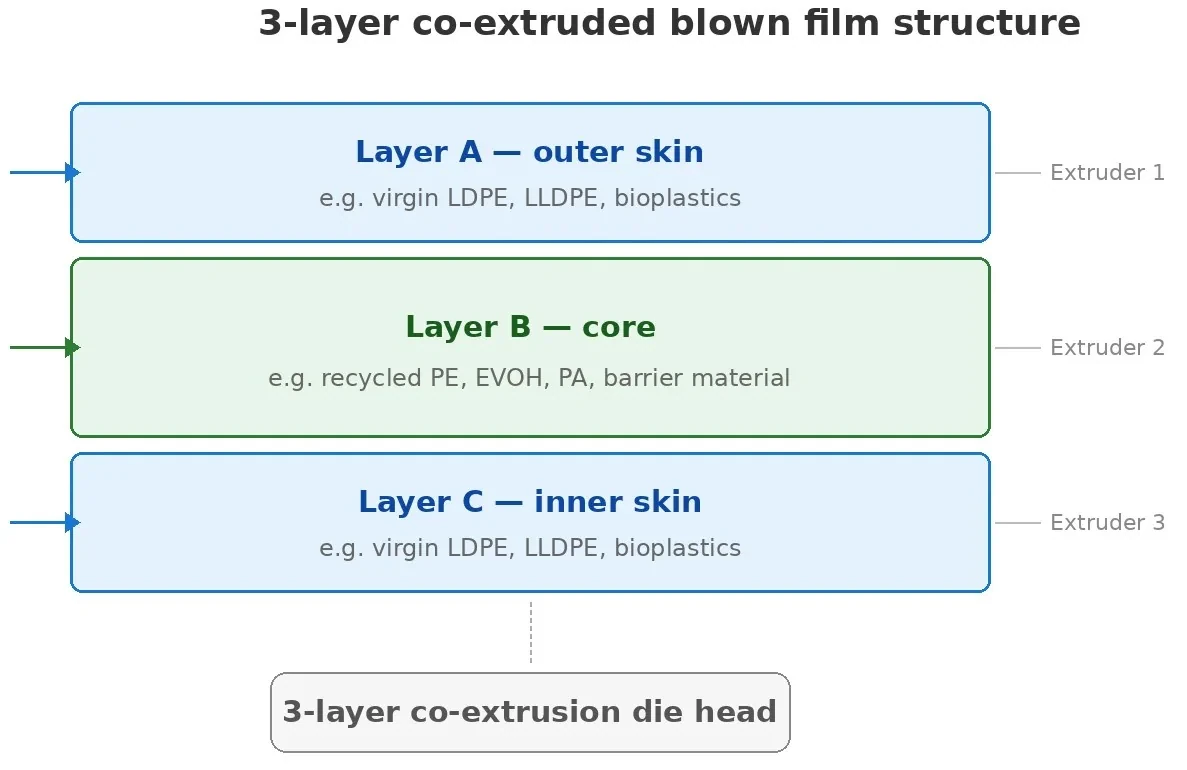
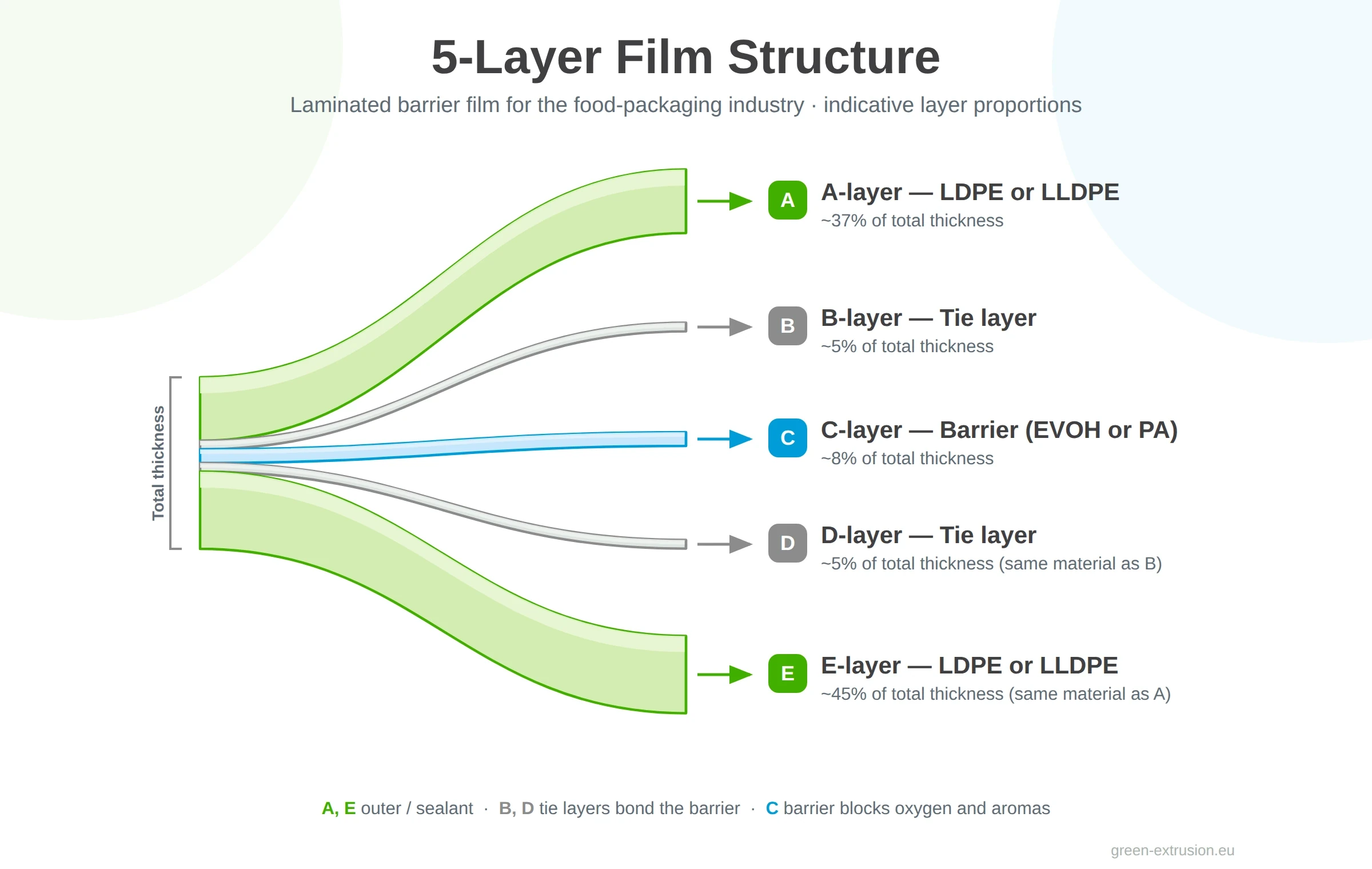
PP can be used in blown film, but it has different behaviour from PE and often requires careful cooling and process control. PA and EVOH are important in multilayer barrier structures but normally need controlled drying and proper tie layers.
EVOH is mainly used as a barrier layer inside multilayer structures, often combined with PE, PA or tie layers. It is not normally evaluated as a simple mono-layer film for standard packaging use.
Multilayer trials are valuable because layer ratios, adhesion, optical appearance and processing stability can be evaluated before full-scale production planning.
Why it matters: Multilayer structures must be evaluated as complete systems, where layer function, adhesion and process stability all matter.
Material groups and typical laboratory test focus
| Material group | What to test | Why it matters |
|---|---|---|
| LDPE, LLDPE, HDPE | Bubble stability, clarity, seal and strength | Main materials for many blown film products |
| PCR and PIR materials | Filtration, gels, odour, colour and pressure | Recycling quality varies between lots |
| PA, EVOH and barrier layers | Drying, adhesion and layer ratio | Barrier films require controlled coextrusion |
| Bio-based polymers | Moisture, temperature window and process stability | Processing behaviour can differ from conventional PE |
| Masterbatch and additives | Dosing, dispersion, slip, antiblock and treatment | Small formulation changes can affect film performance |
Recycled materials and PCR content
Recycled pellets can vary in viscosity, contamination level, odour, colour, moisture and gel content. These variations can affect bubble stability, film clarity, sealing behaviour and mechanical properties.
A good recycling trial should check filtration behaviour, screen pressure, gels, black specks, bubble stability, odour and film appearance. The material should also be compared with a known reference material.
LabEx testing is especially relevant for recyclers because it makes it possible to show customers practical film samples from recycled pellets without occupying a production line.
Bio-based and compostable materials
Bio-PE can often be processed similarly to conventional PE, depending on grade. Compostable polymers and starch blends can behave very differently and may be more sensitive to moisture, temperature and residence time.
PLA and other bio-based compounds often require controlled drying and a careful temperature window. Processing too hot, too long or with too much shear can reduce quality.
Laboratory extrusion helps identify whether a bio-based or compostable compound has a useful blown film window. It also helps universities and material developers compare formulations before scale-up.
Practical point: Specialty structures and sensitive materials benefit from careful laboratory work before larger scale trials are planned.
Additives, masterbatch and formulation testing
Additives can improve slip, antiblock, UV resistance, colour, processing and sealing. They can also create new problems when they migrate, interact with another layer or are dosed incorrectly.
Colour masterbatch must be compatible with the base resin. Poor compatibility or poor dispersion can create streaks, specks and inconsistent film appearance. Dosing accuracy is essential.
A structured laboratory test can compare additive levels and masterbatch formulations before a larger order is placed or a production run is planned.
A practical laboratory test plan
A good laboratory test plan should include material identification, drying record if needed, temperature profile, screw speed, melt pressure, frost line observation, bubble stability, film thickness, appearance and sample identification.
For each trial, only one main variable should be changed at a time. This could be recycled content, masterbatch level, drying condition, layer ratio, temperature or cooling setting.
Film samples should be labelled clearly and stored with the process record. This creates practical knowledge that can be shared between R&D, production, sales and the customer.
LabEx, Multi-X and Green Extrusion support
LabEx laboratory extruders are the natural choice when the goal is to test blown film materials, multilayer structures and small film samples. They are practical for universities, laboratories, material suppliers, recyclers and processors.
Multi-X All-Around Extruders are relevant when the same material must also be tested in other extrusion formats. This is useful for recyclers and compounders that need to understand if a material can work in film, profile, strand, rod or compact production tests.
Green Extrusion Technology can help define a practical laboratory extrusion setup, including extruder size, die head, air ring, take-off, winder, screen changer, control system and possible financing routes for LabEx equipment.
Turn material ideas into practical film samples
Green Extrusion Technology can help define LabEx laboratory extruders, Multi-X extruders and financing routes for material testing, recycled polymers and new film formulations.
Continue the 4-part blown film guide
This article is part of a connected technical series. Use the next articles to understand the full blown film line from pellets to finished film and material testing.
FAQ
Which materials are most common in blown film extrusion?
LDPE, LLDPE, mLLDPE and HDPE are among the most common materials. PP, PA, EVOH, recycled materials and bio-based materials are used for specific applications.
Why test recycled pellets before production?
Recycled pellets can vary in viscosity, contamination, odour, moisture and gel level. A laboratory trial helps show practical processability and film quality.
Can bio-based polymers be tested on a laboratory blown film line?
Yes. LabEx blown film lines are useful for testing bio-based compounds, drying conditions, temperature windows and film appearance.
When is Multi-X relevant?
Multi-X is relevant when a material must be evaluated in other extrusion forms, such as strands, rods, small profiles or compact development tests.
Sources
This article is based on Green Extrusion Technology product knowledge and practical extrusion experience.